Recomend this page
Thank you, we sent your recommendation to the desired recipient.
Sorry, this functionality is not available right now.
Please try with this link. Thank you.


We have made clear commitments to support a just and fair transition and reduce the environmental impact of our operations
At UniCredit, we are committed to meeting our clients' evolving transition needs with a focused, dedicated approach. Our transition plan has defined our pathway to net zero and we have made consistent progress to cut our greenhouse gas emissions and support our clients to do the same.
At the same time, we are developing our environmental framework beyond decarbonisation. As a pan-European bank, we recognise our responsibility to help protect natural capital by providing the financing and support needed to address climate change and biodiversity loss.
In 2024 we published our Statement on Natural Capital and Biodiversity, which considers the circular economy as a key lever to enable us to reach our Net Zero targets, and we have also signed up to the Finance for Biodiversity Pledge (FfBP), committing to taking ambitious action on biodiversity to reverse nature loss in this decade.
Read the full statement here:
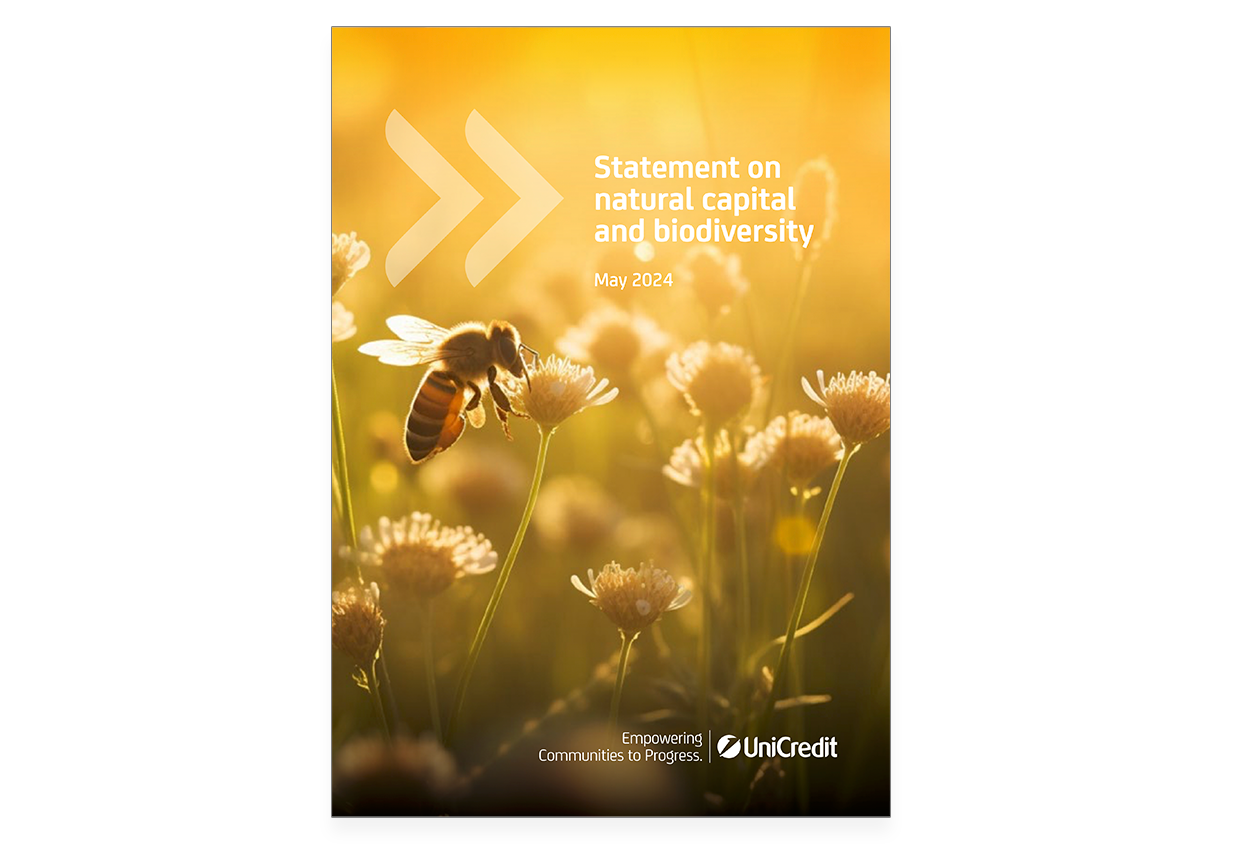
Environmental statement (2026 - Italian only):

Path to Net Zero
We are committed to reaching Net Zero on our own emissions by 2030 and we have been making tangible and consistent progress to cut our greenhouse gas emissions over the last few years through initiatives such as procuring our electricity from renewable sources and improving the energy-efficiency of our premises and data centres.
We are also committed to reaching Net Zero on our financed emissions by 2050 - and in line with UNEP Guidance for FIs, we have outlined interim 2030 targets for seven of our most carbon-intensive client sectors, including an industry-leading phase out policy for coal, as we continue to embed ESG in our financing activities and implement our Net Zero transition plan.
Read more here - Our Net Zero Pathway
Sustainable Finance
At UniCredit, we are committed to meeting our clients' evolving transition needs with a focused, dedicated approach. At the same time, we are developing our environmental framework beyond decarbonisation.
In particular, we support our clients through our Group ESG Advisory team. The ESG Advisory team is a multi-disciplinary team focused on helping clients integrate sustainability into their strategic decisions. This includes advising on stakeholder/ shareholder engagement and activism, access to capital, M&A, supply chains, climate impact guidance and ESG rating and reporting.
We strongly believe in the effectiveness of the sustainable finance market and its ability to channel investments to projects and activities with environmental and social sustainability benefits, and published our Sustainability Bond Framework, which is an important tool for the implementation of UniCredit's ESG Strategy.
Visit our Sustainability Bonds section
Nature related framework
As a pan-European bank, we have a key role to play in protecting our planet's natural capital, providing the financing and economic evolution required to tackle climate change and biodiversity loss.
As part of our commitment to sustainable value creation, we embed environmental considerations into our Group's business strategy, governance, and risk management framework, aiming to minimise negative impacts on ecosystems and communities while supporting the transition to more sustainable economic models.
UniCredit increasingly focuses on broader nature-related challenges, acknowledging the strong interconnection between economic activities and natural capital, biodiversity, ecosystem services, water resources, pollution, and waste management.
To reinforce its role as a catalyst for sustainable transformation, UniCredit is a member of a range of internationally recognised initiatives and commitments, including the UNEP FI Principles for Responsible Banking (PRB), the UNEP FI Biodiversity Working Group, and the Finance for Biodiversity Pledge Foundation. The Group has also published its own Statement on Natural Capital and Biodiversity and supports initiatives aimed at protecting and restoring forests and other natural ecosystems through financing and investment activities.
Recognising the growing importance of nature-related risks, UniCredit has developed a dedicated assessment framework at client and portfolio level fully integrated into the Bank's risk management to identify the most relevant exposures to environmental impacts and dependencies on ecosystem services, acknowledging that nature provides critical resources and functions that support business operations and long-term economic resilience.
Read the full statement here: