Recomend this page
Thank you, we sent your recommendation to the desired recipient.
Sorry, this functionality is not available right now.
Please try with this link. Thank you.


UniCredit's corporate governance system promotes clarity and accountability, while constantly evolving to ensure long-term sustainable value
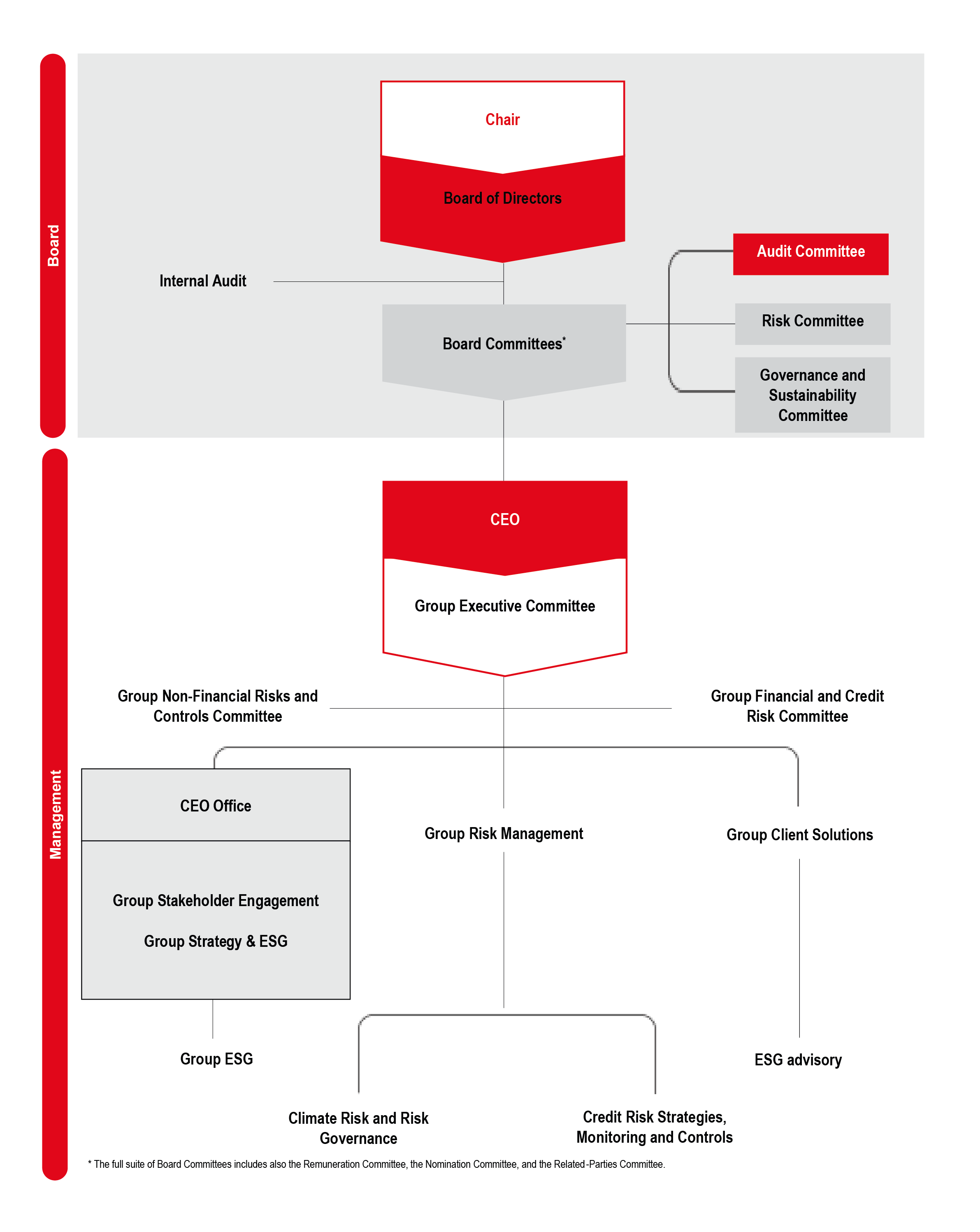
The UniCredit Board of Directors (i) defines the overall strategy of the Bank and the Group, of which the Group's ESG Strategy and its associated KPIs are an important pillar, and oversees its implementation over time, and (ii) establishes policies to govern the risks to which the Group may be exposed, risk targets and tolerance thresholds, as well as reviewing them periodically.
The Governance and Sustainability Committee provides advice and support to the Board on matters related to corporate governance and in fulfilling its responsibilities, while pursuing sustainable success as an integral component of the Group's business strategy and long-term performance.
The Group Executive Committee (GEC) is the Group's most senior executive committee and is chaired by the CEO. Its mission includes establishing the banks' comprehensive ESG strategy, including the formulation of initiatives related to ESG topics, setting targets and guidelines at the Group level.
Click here for more information on the overall Governance of UniCredit Group
ESG Sustainability Policies and Ratings
Environmental and social risk assessments are guided by our environmental, social, operational and reputational risk sector policies as well as by our human rights commitment.
Moreover, our ESG governance includes clear ESG Product Guidelines, introduced in 2022 and regularly updated and enhanced to align with the highest standards. This is with the aim of preventing greenwashing and social washing risks.
• The Guidelines establish a consistent and comprehensive methodology for the classification and reporting of our ESG offering and serve as a basis to build on our sustainability ambitions and metrics.
• This includes a methodology to classify financial products and services offered by UniCredit Group as Green, Social, Transition or Sustainability linked. ESG products include different product categories considering Environmental, Social and Governance characteristics. The policy specifies the classification logic, the eligibility criteria, the applicable environmental and social requirements.
• The Guidelines cover the Group's Legal Entities and business lines: lending products, bonds, investment, hedging, capital market, transactional, and insurance products. They are regularly reviewed to amend or include additional qualifying activities and/or criteria based on market trends or business needs and to comply with regulatory requirements.
Additionally, we proactively and reactively interact with the ESG rating agencies with the aim of communicating and monitoring the Group sustainability strategy and improving our positioning and disclosure. Our sustainability performance is reflected in the key external ratings.
Discover more on our ESG Sustainability Policies and Ratings page
ESG Risk Framework
Environmental, Social and Governance Risk Management is a core component of UniCredit's risk and sustainability framework, ensuring that climate and nature - related risks and opportunities are systematically integrated into business decisions, portfolio management, and strategic planning. UniCredit recognizes that climate change and nature risk can impact both its clients and its own operations through physical risks—such as floods, droughts, and extreme weather events - and transition risks arising from changes in regulation, technology, market dynamics, and customer preferences associated with the move towards a low-carbon economy and nature positive performance.
To address these challenges, UniCredit embeds climate and nature considerations within its enterprise-wide risk management processes and procedures, including credit risk assessment, portfolio monitoring, risk appetite setting, materiality assessment (including ICAAP) and stress testing activities. Specifically, climate-and nature-related factors are incorporated into lending decisions and ongoing client engagement, helping the bank better understand vulnerabilities and support customers in their transition journeys offering a wide spectrum of climate and nature-related products.
Through dedicated governance structures, robust monitoring frameworks, and transparent reporting aligned with international standards, UniCredit continuously strengthens its ability to identify, measure, manage, and mitigate climate and nature -related risks.
The bank also employs climate scenario analysis and resilience assessments to evaluate the potential long-term impacts of climate change and nature related aspects on its portfolios and business model.
By combining sound risk management practices with its sustainability ambitions, UniCredit supports a just and fair transition towards a low-carbon economy, while contributing to the resilience of its clients, communities, and the financial system as a whole.